 ASX: OSM · Orión Project
Minerals Hub / Elements / Accessory Minerals
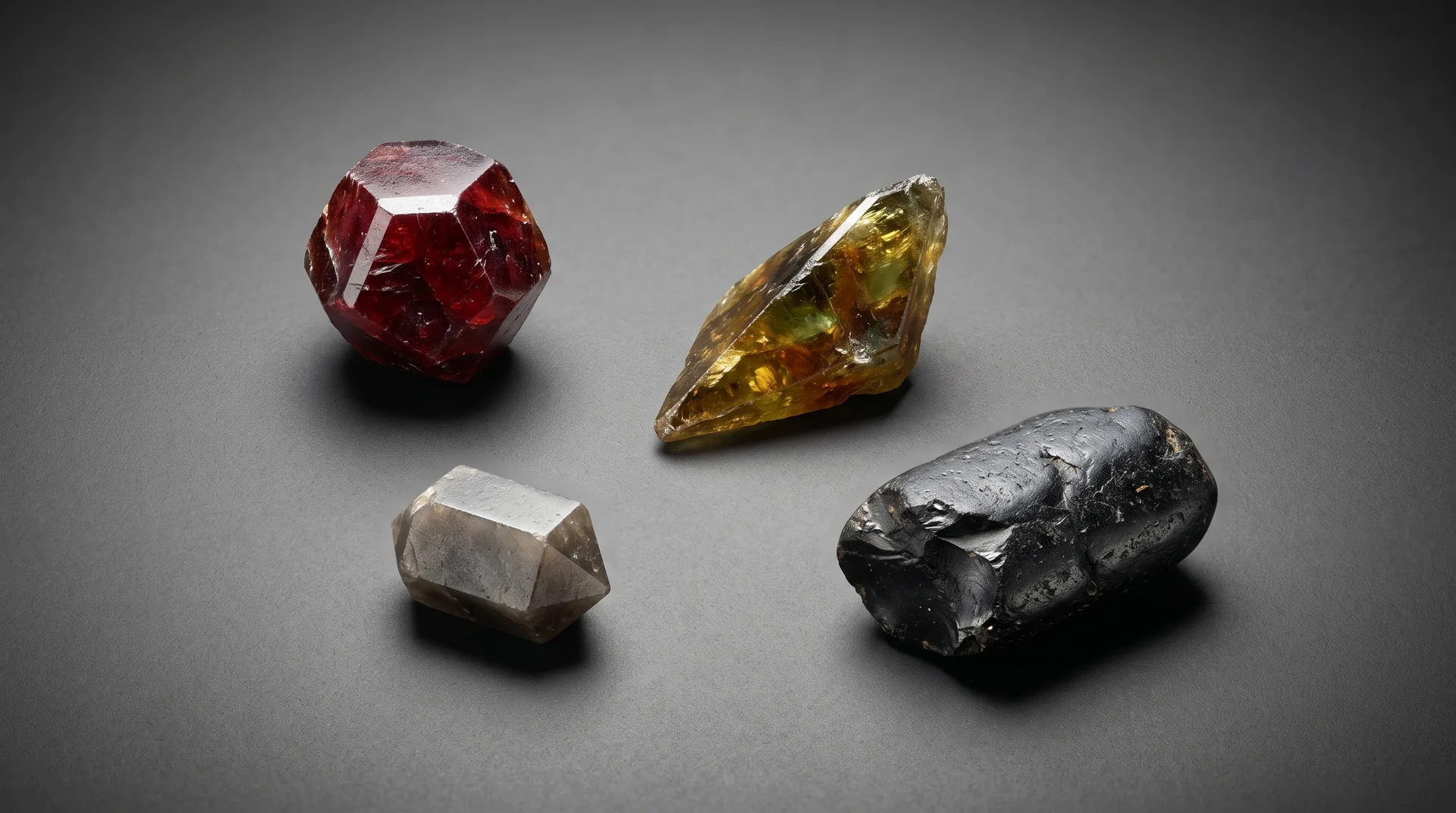
Accessory Minerals
Carried in — the Orión minerals that yield it
What it is
These four minerals rarely headline a deposit. In igneous and metamorphic rocks they are accessory phases, typically less than one volume percent of the host rock, yet they are persistent, dense, and chemically selective enough that placer processes concentrate them to levels worth understanding — and, in some cases, worth recovering. Treating them as a suite rather than four fragments has a specific payoff: two of them carry rare-earth elements in complementary ways — xenotime capturing the heavy rare earths, allanite the lights — while the other two carry essentially none. Seeing that pattern across one page is more useful than encountering each mineral in isolation.
Properties
Garnet
Identity. Garnet is a nesosilicate supergroup with the general end-member formula X₃Y₂(SiO₄)₃, where X occupies the dodecahedral site (Ca²⁺, Mg²⁺, Fe²⁺, or Mn²⁺) and Y the octahedral site (Al³⁺, Fe³⁺, Cr³⁺, or Ti⁴⁺), per the IMA-accepted nomenclature revision (Grew et al. 2013). The principal end-members are pyrope Mg₃Al₂(SiO₄)₃, almandine Fe₃Al₂(SiO₄)₃, spessartine Mn₃Al₂(SiO₄)₃, grossular Ca₃Al₂(SiO₄)₃, andradite Ca₃Fe₂(SiO₄)₃, and uvarovite Ca₃Cr₂(SiO₄)₃. Natural garnets are almost always solid solutions between two or more of these.
Properties. Hardness varies with composition: almandine and pyrope sit at Mohs 7–7.5, grossular and andradite at 6.5–7. Specific gravity likewise varies: almandine 3.95–4.20, pyrope 3.51–3.87, spessartine 4.12–4.32, grossular 3.57–3.73, andradite 3.81–3.87 (Deer, Howie & Zussman 2013).
Occurrence and processing. Almandine-rich garnet is the principal placer variety globally, sourced from the metapelitic schists and gneisses — the pelitic metamorphic rocks — that dominate many sediment-supplying terranes. It concentrates by the same hydrodynamic mechanism as ilmenite, rutile, and zircon, and its resistance to chemical weathering gives it good persistence through transport, though it is less durable than zircon. In processing circuits, almandine is weakly paramagnetic owing to its Fe²⁺ content; high-intensity magnetic separation can therefore separate it from diamagnetic minerals such as zircon, though its susceptibility overlaps with some ilmenite fractions and circuit design requires care.
What it carries. Standard rock-forming garnets — almandine, pyrope, grossular — carry negligible rare-earth or radioactive elements. This makes garnet the least radiologically complex product in any heavy-mineral concentrate, simplifying handling relative to zircon, monazite, or the two REE-bearing minerals on this page. Rare grandite or melanite garnets can incorporate REEs, but these are not the placer industrial varieties.
Uses. The dominant industrial application is abrasive: garnet grit is the principal abrasive medium in waterjet cutting of metals, stone, and composites, and is also used in blasting, surface preparation, and coated abrasives. Hardness around 7.5, angular fracture on breakage, and low toxicity are the enabling properties. A secondary use is as a filter medium in multi-media water-filtration systems, where its high density and controllable grain size produce a tightly packed, backwash-resistant filter bed, typically placed beneath anthracite layers (USGS MCS Garnet 2024).
---
Titanite (Sphene)
Identity. Titanite is the IMA-accepted name; sphene is retained as a synonym and persists in some industrial usage. The ideal formula is CaTiSiO₅, equivalently written CaTiO(SiO₄) to emphasise the crystal structure: isolated SiO₄ tetrahedra linked by Ca in eightfold coordination and Ti in sixfold (octahedral) coordination. It is monoclinic (space group P2₁/a) and forms characteristic wedge- or envelope-shaped crystals.
Properties. Mohs hardness is 5–5.5. Specific gravity is 3.48–3.60 for natural compositions (Deer, Howie & Zussman 2013); near-stoichiometric compositions cluster toward the lower end of this range (3.48–3.55), with higher values reflecting Fe³⁺ and REE substitution. Stoichiometric TiO₂ content, computed from stoichiometry using CIAAW 2021 standard atomic weights, is ≈40.7 wt% TiO₂. Natural titanite contains less, because Ti is partially replaced by Al, Fe³⁺, Nb, and other elements.
Occurrence. Titanite is a common accessory mineral in intermediate to felsic igneous rocks — granodiorites, syenites, diorites — and in calc-silicate metamorphic rocks and some amphibolites. It is uncommon in mafic rocks and rare in highly silicic granites, where rutile or ilmenite are the preferred titanium phases.
What it carries. Titanite accommodates significant light rare-earth substitution on the Ca site via the coupled substitution Ca²⁺ + Ti⁴⁺ → REE³⁺ + Al³⁺ (or Fe³⁺), making it a geochemically important LREE-bearing phase in some granitic and metamorphic systems. It also incorporates U and Th, which has made it a useful geochronological mineral — U-Pb titanite dating is a well-established technique.
Processing behaviour and uses. Despite its moderately high stoichiometric TiO₂ content, titanite is rarely exploited as a titanium ore. Its silicate matrix does not respond well to the standard sulfate or chloride processing routes designed for ilmenite and rutile; it occurs at too-low concentrations in most host rocks to be economically concentrated; and its lower SG (~3.5) and hardness (Mohs 5–5.5) make gravity separation from silicate gangue less efficient than for rutile (SG 4.18–4.25) or ilmenite (SG 4.5–5.0). In heavy-mineral sand circuits, titanite reports variably to the non-magnetic or weakly magnetic fraction depending on its Fe³⁺ content, and is generally treated as a gangue or low-value by-product rather than a target mineral.
---
Xenotime
Identity. Xenotime is a rare-earth phosphate with the ideal formula YPO₄, crystallising in the tetragonal system (space group I4₁/amd) and isostructural with zircon (ZrSiO₄). The Y site accommodates extensive substitution by heavy rare-earth elements, making xenotime the principal HREE-bearing phosphate mineral. Stoichiometric composition, computed from stoichiometry using CIAAW 2021 atomic weights, is ≈61.4 wt% Y₂O₃ and ≈38.6 wt% P₂O₅; natural xenotime Y₂O₃ content is lower due to HREE and other substitutions, typically reported in the range 52–61 wt% Y₂O₃ in electron microprobe analyses (Förster 1998).
Properties. Mohs hardness is 4–5, commonly cited as 4.5. Specific gravity is 4.4–5.1 across the natural compositional range; Y-dominant compositions typically fall in the range 4.45–4.59 (Deer, Howie & Zussman 2013), while the upper end of the range reflects HREE-, U-, and Th-enriched compositions (Förster 1998).
Occurrence. Xenotime is a primary accessory mineral in peraluminous granites, pegmatites, and high-grade metamorphic rocks including paragneisses and migmatites. It also forms diagenetically in sedimentary basins as an authigenic overgrowth on detrital zircon grains at temperatures above approximately 60–80°C — a property that has made diagenetic xenotime an important tool in basin geochronology (Rasmussen 2005).
What it carries. The heavy rare-earth elements that substitute for Y in xenotime include Dy, Er, Yb, Gd, Ho, Tb, Tm, and Lu — all HREE by IUPAC convention — as well as Th and U in lesser amounts. Light REEs such as La, Ce, Pr, and Nd are strongly excluded by the small ionic radius of the Y site, making xenotime chemically complementary to monazite, which preferentially hosts LREEs. HREEs are less abundant in the Earth's crust than LREEs (by the Oddo-Harkins rule) and concentrate in fewer mineral hosts; xenotime and ion-adsorption clay deposits are the principal commercial HREE sources. Xenotime also contains Th and U as substituting cations, making it a mildly to moderately radioactive mineral, with implications for the handling and transport of xenotime-bearing heavy-mineral concentrates.
Processing behaviour. Xenotime is isostructural with zircon and commonly occurs in intimate association with detrital zircon in placer deposits; the two minerals are nearly identical in morphology and have overlapping SG ranges, making physical separation challenging. Xenotime also forms epitaxial overgrowths on zircon grains. Separation from zircon relies primarily on differences in magnetic susceptibility — xenotime is more paramagnetic due to its HREE, U, and Th content — and on electrostatic separation, where xenotime is more conducting than zircon under high-voltage fields. These separations are imperfect given the structural and density similarities, and specific separation efficiencies are circuit- and feed-dependent.
---
Allanite
Identity. Allanite is a member of the epidote group (sorosilicate subclass), with the general structural formula A₂M₃(SiO₄)(Si₂O₇)O(OH). The A sites, large and eightfold-coordinated, accommodate Ca²⁺, REE³⁺ (especially Ce, La, Nd), Th⁴⁺, and Mn²⁺; the M sites (octahedral) accommodate Al³⁺, Fe²⁺, Fe³⁺, and Mn²⁺. IMA suffix nomenclature distinguishes allanite-(Ce), allanite-(La), and allanite-(Y) by their dominant REE, per Armbruster et al. (2006). Allanite-(Ce) is by far the most common natural variety; its ideal end-member formula is CaCe(Al₂Fe²⁺)(SiO₄)(Si₂O₇)O(OH), though in practice most natural allanites are REE-bearing clinozoisite-allanite solid solutions rather than true end-members.
Properties. Mohs hardness is 5.5–6. Specific gravity is 3.4–4.2, with higher values reflecting greater Fe²⁺/Fe³⁺ and REE content — a wide range that reflects genuine compositional variability and should not be applied without qualification. Allanite is monoclinic (space group P2₁/m), forming prismatic to tabular crystals. Fresh crystalline material has a vitreous lustre; heavily metamict specimens develop a resinous to submetallic lustre. Colour ranges from pale yellow-brown in low-REE, low-metamictisation material to black in high-Fe, high-REE, heavily metamict specimens.
Occurrence. Allanite is a primary LREE host in granites, granodiorites, pegmatites, and some calc-silicate skarns. In peraluminous granites it commonly coexists with monazite and xenotime. The allanite-to-monazite transition is temperature- and bulk-composition-dependent. Wing, Ferry & Harrison locate it at the aluminosilicate isograd rather than at a stated temperature; papers converting that isograd to a number place it at roughly 525–600°C in metapelitic systems — allanite is dominant at lower temperatures, with monazite replacing it as temperature rises (Wing, Ferry & Harrison 2003).
What it carries. Allanite hosts LREEs, with Ce and La dominant. Typical total REO content is 10–20 wt% for allanite-(Ce) in granitic systems, with exceptional pegmatitic specimens reaching up to approximately 30 wt% REO (Gieré & Sorensen 2004); this range is indicative for Ce-dominant granitic allanite and should not be applied to all natural allanite compositions without qualification. Allanite incorporates Th preferentially over U, with Th/U ratios typically greater than 10, meaning that allanite-bearing concentrates can carry significant thorium radioactivity even at modest allanite concentrations.
Metamictisation and processing behaviour. Allanite undergoes progressive radiation damage — metamictisation — due to alpha-decay of incorporated U and Th, disrupting the crystal lattice from a crystalline to an amorphous state over geological time. Heavily metamict allanite loses its sharp X-ray diffraction peaks and acquires lower SG, higher porosity, and altered colour relative to crystalline material (Gieré & Sorensen 2004). This matters for processing: metamict allanite is physically weaker and more prone to fine-particle generation during milling, reducing recovery in gravity circuits; its amorphous structure is more susceptible to leaching and oxidation, complicating hydrometallurgical flowsheet design; and radiation damage alters magnetic susceptibility, making separation responses less predictable. Annealing at approximately 300–700°C can partially restore crystallinity but adds process complexity.
Beyond metamictisation, allanite presents additional processing challenges. Its sorosilicate matrix is more acid-resistant than the phosphate matrix of monazite or xenotime, requiring more aggressive leach conditions to liberate REEs. The coupled substitution of Fe²⁺/Fe³⁺ means that REE extraction chemistry is entangled with iron chemistry, complicating selective leaching. And REE grades in allanite are moderate rather than the higher grades achievable in monazite or bastnäsite, which affects the economics of any recovery attempt. Allanite is also less persistent as a detrital mineral than zircon, monazite, or xenotime, owing to its lower hardness, susceptibility to metamict-state physical breakdown, and moderate chemical weathering resistance; it is therefore less commonly a target mineral in heavy-mineral sand operations.
---
Occurrence
Heavy-mineral placer deposits form because flowing water, wind, or wave action sorts particles by density. All four minerals have specific gravity well above 3.5, which places them in the range where gravity-based separation from quartz and feldspar gangue (SG ~2.65) is practical using spirals, cones, and shaking tables. Garnet occurs in heavy-mineral sand assemblages and is tracked as a distinct commodity by the USGS (MCS 2024); titanite, xenotime, and allanite appear in USGS and industry literature as accessory phases in heavy-mineral sand and rare-earth mineral contexts but are not individually tracked as primary HMS commodities in USGS Mineral Commodity Summaries. The SG advantage that concentrates them also concentrates their companions — ilmenite, rutile, zircon, monazite — which is why these four are almost always found in the same processing streams as those better-known minerals.
---
Industrial importance
REE complementarity
The four minerals fractionate rare-earth elements in ways governed by ionic radius control on crystal-site selectivity across the lanthanide series. Allanite hosts LREEs, with Ce and La dominant on its large A sites. Xenotime hosts HREEs — Dy, Er, Yb, and their neighbours — on the small Y site that excludes the larger light lanthanides. Titanite hosts moderate LREEs via coupled substitution on the Ca site. Almandine garnet, in typical placer compositions, hosts negligible REEs. The result is that a heavy-mineral concentrate carrying all four minerals contains a complementary REE inventory: light rare earths in the allanite fraction, heavy rare earths in the xenotime fraction, with garnet and titanite contributing little to the REE balance. Understanding which mineral carries which REEs is therefore a prerequisite for any rational approach to REE recovery from a mixed accessory-mineral concentrate.
Radioactivity: a gradient, not a uniform hazard
All four minerals can carry U and Th to varying degrees, but the gradient across the suite is large. Garnet in standard placer compositions carries the least — effectively negligible. Titanite incorporates U and Th at levels useful for geochronology but modest in processing terms. Xenotime and allanite sit at the other end: xenotime through direct U⁴⁺ and coupled Th substitution on the Y site, allanite through strong preferential Th incorporation with Th/U ratios typically exceeding 10. Any heavy-mineral processing stream that concentrates these minerals may require radiation monitoring under applicable NORM frameworks (IAEA Safety Reports Series No. 68, 2007); the degree of concern scales with the Th and U content of the feed and the degree of concentration achieved. This is a practical engineering and regulatory consideration, not a reason to treat these minerals as exotic hazards — the same NORM framework applies to zircon and monazite processing, which are far more commonly handled at industrial scale.
- PRIMARYGrew et al., 'Nomenclature of the garnet supergroup', American Mineralogist 98(4), 785–811, 2013
- PRIMARYArmbruster et al., 'Recommended nomenclature of epidote-group minerals', European Journal of Mineralogy 18, 551–567, 2006
- PRIMARYDeer, Howie & Zussman, An Introduction to the Rock-Forming Minerals, 3rd ed., 2013No public URL · citation pending
- PRIMARYGieré, R. & Sorensen, S.S., 'Allanite and other REE-rich epidote-group minerals', Reviews in Mineralogy and Geochemistry 56, 431–493, 2004
- PRIMARYFörster, H.-J., American Mineralogist 83, 1302–1315, 1998 (Part II: Xenotime)
- PRIMARYRasmussen, B., Earth-Science Reviews 68, 197–243, 2005
- PRIMARYWing, Ferry & Harrison, Contributions to Mineralogy and Petrology 145, 228–250, 2003
- PRIMARYSpear, F.S. & Pyle, J.M., Reviews in Mineralogy and Geochemistry 48, 293–335, 2002
- PRIMARYUSGS Mineral Commodity Summaries — Garnet, 2024
- PRIMARYProhaska et al., Pure Appl. Chem. 94(5), 573–600, 2022 — Standard Atomic Weights 2021
- PRIMARYIAEA Safety Reports Series No. 51, 2007 — NORM in the zircon and zirconia industries