Minerals Hub / Applications & Industries / The niobium alloy that carries hafnium to orbit
Applications & Industries · · 4 min read
The niobium alloy that carries hafnium to orbit
One refractory alloy, ten per cent hafnium by weight, has been flying on spacecraft since Apollo — and the world has no published figure for how much hafnium exists.
Reviewed by Peter Uppal
The short version
The alloy is C-103, and NASA describes it as Nb-10Hf-1Ti by weight — roughly a tenth hafnium. It is used, in NASA's words, in aerospace applications in sustained high temperature operating environments, and NASA records that it was developed in the 1960s. The awkward fact behind it is statistical rather than metallurgical: the USGS states that world primary hafnium production data 'were not available'.
An alloy defined by what it can sit next to
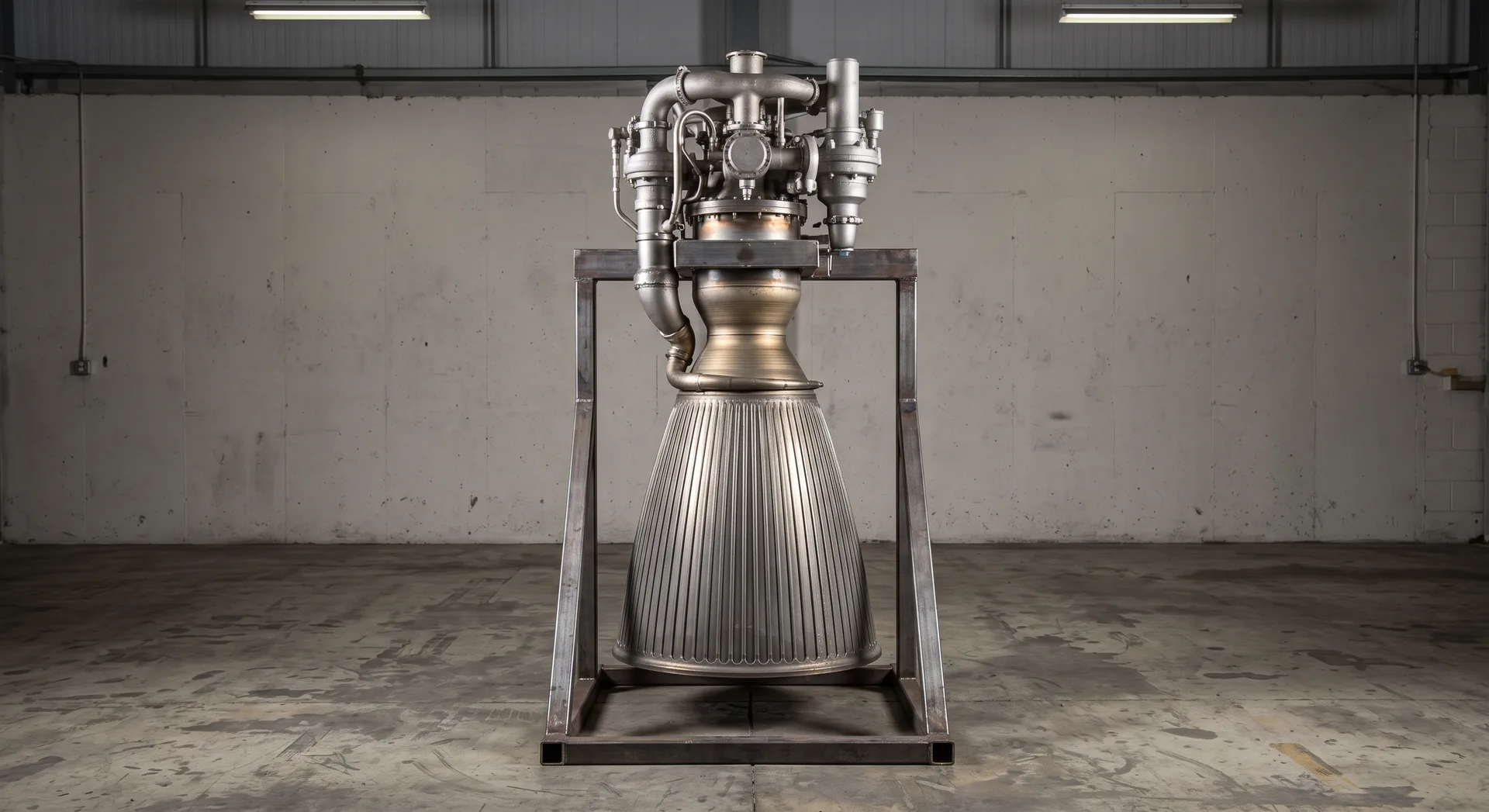
Above the atmosphere the constraints that matter are temperature and mass, and a small number of materials sit where both are extreme at once. A rocket nozzle extension or a small thruster chamber may have no cooling except radiating heat away, which means the metal itself has to survive the gas temperature.
C-103 is one of the answers, and it is nearly as old as spaceflight. NASA records that it was developed in the United States by Boeing & Wah Chang Corp in the 1960s, and that the alloy is solid-solution strengthened — a description of the alloy as a whole. It is worth being careful here: sources read for this article do not attribute a specific strengthening or oxidation-resistance mechanism to hafnium's presence in this alloy, and none is asserted. What is documented is that hafnium is a tenth of it, and that this is expensive: NASA states the alloy is expensive due to the Hf content.
The oxidation problem is real and is solved externally rather than by chemistry. NASA states that C103 is typically employed with a high-temperature oxidation-resistant coating (Si-20Cr-20Fe, tradename: R512E). A niobium alloy that needed no coating would be a different material; this one is a substrate plus a silicide layer, and the pairing is the product.
Flight heritage, stated exactly
The heritage claim circulating around C-103 is broader than the sourcing supports, and it is worth narrowing. A characterisation study presented at the GEM 2023 Annual Conference describes the alloy as Nb alloy, C-103, with 10 wt.% Hf, and 1 wt.% Ti, with a density less than 9 g/cc, and states that it was used to make the Apollo command service module, reaction control system R-4D thruster.
That is the Command and Service Module's attitude-control thruster. Claims that the same alloy made the Lunar Module descent engine appear widely but were not found in any NASA document read for this article, and are therefore absent from it.
It is also not automatically the winning choice. Assessing nozzle extension options for an upper-stage engine, a NASA paper records C-103 being weighed against composite alternatives, with carbon-carbon selected 'primarily due to weight considerations (versus the C-103 option)'. A refractory metal that works is still a heavy thing to carry to orbit.
Hafnium's place in spaceflight is not glamorous and not large. It is a tenth of one alloy, in parts nobody photographs, that nothing cheaper survives.
The second hafnium job, on the ground and in the air
Hafnium's better-documented metallurgical role is in nickel-based superalloys, where the record goes back further. The Superalloys 1980 proceedings report that with the addition of hafnium to directionally solidified MAR-M200 in 1969, 'transverse grain boundary strength and ductility were significantly improved'. The USGS's own summary of what hafnium is for begins in the same place: the leading use of hafnium metal is in superalloys, with the fuller list running to high-temperature ceramics, nickel-base superalloys, nozzles for plasma-arc metal cutting, and nuclear control rods.
Two of those four uses are turbine hardware, which is why hafnium shows up twice in any account of propulsion: once inside the superalloy of a turbopump or a blade, once as the tenth part of a refractory alloy in a chamber that no superalloy would survive.
The number that does not exist
For a material this specific, the supply picture is remarkably thin. The USGS names the producing countries — zirconium and hafnium metals were produced in China, France, India, Russia, and the United States — and then declines to quantify: world primary hafnium production data and quantitative estimates of hafnium reserves were not available.
That absence is the honest supply statement about hafnium. It is not that the metal is known to be desperately scarce; it is that the public statistical record does not say how much there is, which is a different and more awkward position for anyone planning around it.
At the mineral end, Osmond reports hafnium as an oxide fraction inside zircon-bearing rock: HfO₂ at 1,178–1,204 ppm in the Zone 1 bulk channel samples, on a mass-balance basis. Parts per million in a rock, in a mineral concentrate that does not yet exist, several separations away from a thruster.
Exploration results and mineralogical estimates only. Orión has no JORC-compliant Mineral Resource or Reserve; maiden MRE and Scoping Study pending, targeted Q3 CY26.
Related
- Hafnium — the element, and its separation from zirconium
- Semiconductors — the same element doing an unrelated job
- Aerospace — the atmospheric half of the same engineering problem
- Defence — the procurement rules that govern much of this hardware
Sources
- PRIMARYNASA, 'Additive Manufacture of Refractory Alloy C103 for Propulsion Applications', AIAA paper, 26 May 2020 (NTRS 20205003679), Introduction — 'C103 (Nb-10Hf-1Ti) is solid-solution strengthened niobium alloy used in aerospace applications in sustained high temperature operating environments'. Solid-solution strengthening is attributed to the alloy, not specifically to hafnium.
- PRIMARYNASA, 'A Comparison of Niobium Alloys C103 and Nb521' (NTRS 20250002178, 2025) — 'C103 (Nb-10Hf-1Ti [wt%])'; developed 'in the United States by Boeing & Wah Chang Corp in the 1960s'; 'C103 is typically employed with a high-temperature oxidation-resistant coating (Si-20Cr-20Fe, tradename: R512E)'; and that the alloy 'is expensive due to the Hf content'.
- PRIMARYFietek, C.J., 'Characterizing Microstructure and Properties of a Niobium Alloy Subject to Various Heat-Treatments' — affiliation and hosting UNRESOLVED: this label records the affiliation as printed as The National GEM Consortium and hosting on NASA NTRS 20230011948, 14 September 2023, while the retrieved extract of the same document records 'Carter J. Fietek, NASA STEM, presented at the GEM 2023 Annual Conference' and says nothing about NTRS hosting; neither the affiliation nor the hosting is asserted in the body — the alloy described as 'Nb alloy, C-103, with 10 wt.% Hf, and 1 wt.% Ti' with 'a density less than 9 g/cc', and 'Used to make the apollo command service module, reaction control system R-4D thruster.' This source supports the Command/Service Module R-4D thruster only — not the Lunar Module descent engine.
- PRIMARYNASA / 70th International Astronautical Congress, 'Extreme-Temperature Carbon- and Ceramic-Matrix Composite Nozzle Extensions for Liquid Rocket Engines', Washington D.C., 21–25 October 2019 (NTRS 20190033315) — a niobium alloy (C-103) considered alongside carbon-composite options for a nozzle extension, with carbon-carbon selected 'primarily due to weight considerations (versus the C-103 option)'.
- PRIMARY'The Development of Single Crystal Superalloy Turbine Blades', Superalloys 1980 proceedings (TMS), pp. 205–214 — 'With the addition of hafnium to D.S. MAR-M200 in 1969, transverse grain boundary strength and ductility were significantly improved.' This supports a grain-boundary role in a nickel superalloy; it does not support an oxidation-resistance role, and none is claimed here.
- PRIMARYU.S. Geological Survey, Mineral Commodity Summaries 2025 — Zirconium and Hafnium (January 2025) — 'The leading use of hafnium metal is in superalloys'; 'World primary hafnium production data and quantitative estimates of hafnium reserves were not available.'
- PRIMARYU.S. Geological Survey, 2020 Minerals Yearbook — Zirconium and Hafnium (advance release) — 'The principal uses of hafnium were in high-temperature ceramics, nickel-base superalloys, nozzles for plasma-arc metal cutting, and nuclear control rods'; and 'Zirconium and hafnium metals were produced in China, France, India, Russia, and the United States.'
- PRIMARYosm_grade — ASX:OSM release, 19 Feb 2026 (Zone 1 bulk channel samples: HfO₂ 1,178–1,204 ppm; mass-balance basis).
- UNVERIFIEDGAP — no NASA source was obtained supporting C-103 in the Apollo Lunar Module descent engine or in the Service Module main engine, though both claims circulate. No clean statement of a C-103 service temperature range was obtained either; the sources read give coating-dependent operating figures in passing rather than a defined range, and none is quoted.Non-public document · no public URL
- UNVERIFIEDGAP — no source was obtained attributing grain refinement or oxidation resistance in C-103 specifically to its hafnium content. The sources read point the other way on oxidation: the alloy is described as requiring an external silicide coating.Non-public document · no public URL