
Minerals Hub / Markets & Economics / The road to a maiden resource: what has to happen, and when
Markets & Economics · Rutile · 4 min read
The road to a maiden resource: what has to happen, and when
An explorer's first JORC resource is a specific milestone with specific prerequisites — here's the process, and the schedule Osmond says it is targeting.
Reviewed by Peter Uppal
The short version
A maiden Mineral Resource Estimate (MRE) is a company's first JORC-compliant statement of tonnage and grade — and Orión does not have one yet. Reaching it requires enough drilling, quality-controlled assays, a geological model, and an estimate classified by a Competent Person (JORC 2012). Osmond has said it is targeting a maiden MRE to support a Scoping Study before the end of Q3 CY26, with a larger updated estimate targeted for December 2026. Those are the company's stated targets, described here as exactly that.
What a maiden resource actually is
In the reporting framework used by Australian-listed explorers — the JORC Code — there is a hard line between what a company has found and what it can call a resource. Drill results, channel samples and grade estimates are "Exploration Results." A Mineral Resource is something more: an estimate of tonnage and grade, at defined levels of geological confidence (Inferred, then Indicated, then Measured), signed off by a Competent Person (JORC 2012).
A maiden resource is simply the first time a project crosses that line. It converts a scatter of promising holes into a single, standardised estimate that others can scrutinise. Orión has not crossed it: the project is at the exploration-results stage, and no JORC Mineral Resource exists for it today.
What has to happen
Getting from exploration results to a maiden estimate is a sequence, not a switch. Broadly, and in general JORC terms, it takes four things.
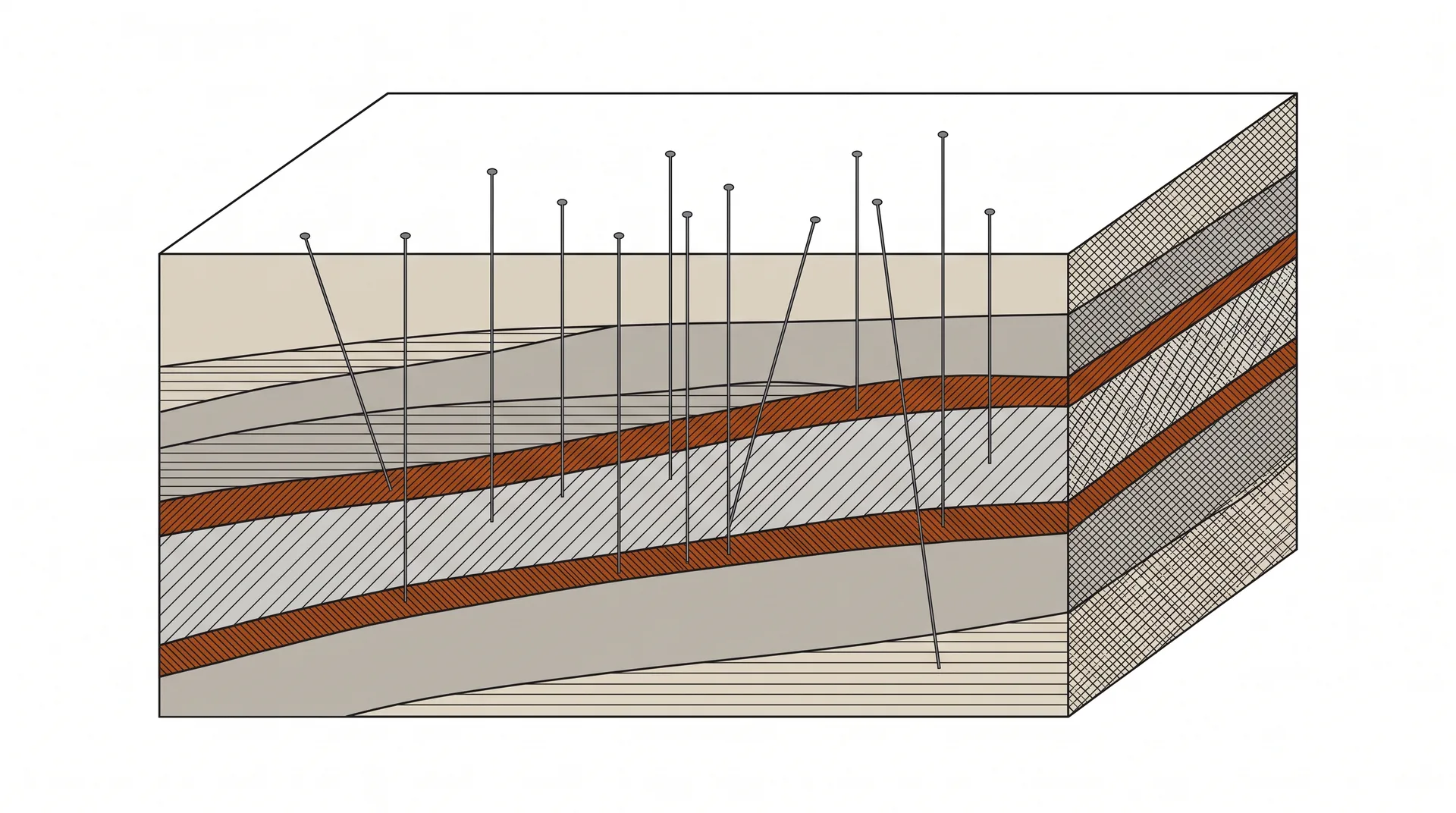
First, enough drilling, at spacing tight enough to characterise the mineralised layers with confidence. Second, quality-controlled assays — the laboratory grades, with the sampling and QA/QC that let a Competent Person trust them. Third, a geological model: an interpretation of how the mineralised seams sit in three dimensions. And fourth, the estimate itself — grades and volumes turned into tonnage-and-grade blocks, then classified by confidence and signed off (JORC 2012).
For context on where Orión stands in that sequence, Osmond reported a drilling program of 9 holes for 2,806 metres as at 19 February 2026, with assays still pending on several (osm_grade). That is drilling-and-assay territory — the input stage for an estimate, not the estimate itself.
When — the schedule Osmond is targeting
On timing, the only appropriate figures are the ones Osmond has published, and they are stated as targets. In its 3 July 2026 release, the company said it is targeting a maiden MRE to support a Scoping Study before the end of Q3 CY26. The 14 August 2026 release sharpened the nearest milestone: the maiden MRE is now expected over the coming four weeks from that date. It also described a second drilling program of 13 holes, planned for late September / early October 2026, feeding a larger, updated MRE targeted for December 2026. Separately, it noted a downstream MREC pre-feasibility study, with Técnicas Reunidas, due in the quarter current at the date of that release (3 July 2026) (osm_drivers).
The word doing the work in every one of those is "targeted." These are forward-looking milestones the company has set for itself, not events that have happened, and — like any exploration schedule — they are subject to drilling, assays and factors outside a timetable. This article reports them; it does not forecast whether or when they will be met.
Why the distinction is the whole point
The reason to be so careful is that the gap between "exploration results" and "maiden resource" is exactly where an early-stage story is easiest to over-read. A strong drill hole is genuinely informative, but it is not tonnage; a target date is a plan, not a delivery. The JORC framework exists precisely to keep those things separate and to make the crossing from one to the other auditable.
So the honest way to read Orión's road to a resource is procedural: a defined set of steps, a set of dates the company is aiming at, and a Competent Person's sign-off that has not yet happened. What a maiden resource would be worth, and what it might mean for anyone, are not questions this milestone answers — and not ones this article will.
A drill intercept is a sentence. A maiden resource is the first paragraph that the rest of a project's story has to be built on.
Milestone card — Orión (as stated by Osmond)
| Current stage | Exploration results only; no JORC Mineral Resource |
| Drilling to date | 9 holes / 2,806 m as at 19 Feb 2026 (osm_grade) |
| Maiden MRE | Targeted to support a Scoping Study before end Q3 CY26 (osm_drivers, 3 Jul 2026) |
| Second program | 13 holes, late Sep / early Oct 2026 (osm_drivers, 3 Jul 2026) |
| Updated MRE | Targeted December 2026 (osm_drivers, 3 Jul 2026) |
| Downstream | MREC pre-feasibility study (Técnicas Reunidas), due in the quarter current at that release (osm_drivers, 3 Jul 2026) |
→ See the Orión project overview in the hub.
Exploration results and mineralogical estimates only. Orión has no JORC-compliant Mineral Resource or Reserve; maiden MRE and Scoping Study pending, targeted Q3 CY26.
Sources
- Osmond schedule and program: [osm_drivers — 3 Jul 2026], [osm_grade — 19 Feb 2026] (ASX:OSM releases)
- JORC Code (2012 Edition)
Related reading
- How to read an early-stage mineral-sands explorer (Investment)
- Why co-products change mineral-sands economics (Investment · How the category works)
- From outcrop to 187.8 metres: what the maiden drilling found (The Deposit · Rutile)
Sources
- PRIMARYosm_drivers — ASX:OSM release, 3 Jul 2026 (schedule: maiden MRE targeted to support a Scoping Study before end Q3 CY26; 13-hole second program late Sep/early Oct 2026; updated MRE targeted Dec 2026; downstream MREC pre-feasibility study with Técnicas Reunidas due in the quarter current at that release).
- PRIMARYosm_grade — ASX:OSM release, 19 Feb 2026 (program status: 9 holes / 2,806 m as at 19 Feb 2026, assays pending on several).
- PRIMARYJORC Code (2012 Edition) — framework and definitions for Exploration Results, Mineral Resources (Inferred/Indicated/Measured) and the role of the Competent Person: https://www.jorc.org/docs/JORC_code_2012.pdf