Minerals Hub / Geography & Supply Chains / Europe owns the middle of titanium — and neither end.
Geography & Supply Chains · Rutile · 5 min read
Europe owns the middle of titanium — and neither end.
Europe turns titanium ore into pigment as well as anyone — but it mines none of the ore and forges none of the metal. The strength is in the middle of the chain.
Reviewed by Peter Uppal
The short version
Titanium isn't one market; it's three stages — ore, oxide, metal — and Europe's position flips as you move along it. On SCRREEN's 2016–2020 figures, the EU is about 100% import-reliant on titanium mineral concentrate (the ore, measured as Ti content), largely self-supplied on TiO₂ pigment (the oxide, 18% import reliance), and 100% import-reliant on titanium metal, with no EU sponge capacity at all. Europe owns the processing middle and neither raw end. That shape — not a single shortfall number — is the titanium supply story.
Three stages, not one number
Titanium moves through three stages — ore, oxide, metal — and the quantities at each differ enormously. That is the first thing to know, because it means "how much titanium does Europe use?" has no single answer: the number only means something once you say which stage it describes.
It starts as titanium mineral concentrate — the ore products, rutile and ilmenite, measured as titanium content. Most of that is processed into titanium dioxide (TiO₂), the white pigment that is by far titanium's largest use. A much smaller slice is reduced all the way to titanium sponge and metal. On SCRREEN's 2016–2020 figures, EU consumption is roughly 456,539 t/yr at the ore stage, 425,694 t/yr at the oxide stage, and just 9,812 t/yr at the metal stage — all expressed as Ti content. The ore and metal figures differ by nearly fifty times. Quote one number for "European titanium demand" and you've said almost nothing; the stage is the whole meaning.
Two cautions, kept in view throughout: these are 2016–2020 averages, not current-year readings, and each figure names a specific substance at a specific stage. Ti mineral concentrate, TiO₂ and titanium metal are not interchangeable tonnages.
The middle Europe owns
Now the interesting part — where Europe is actually strong. It's the oxide stage, the pigment.
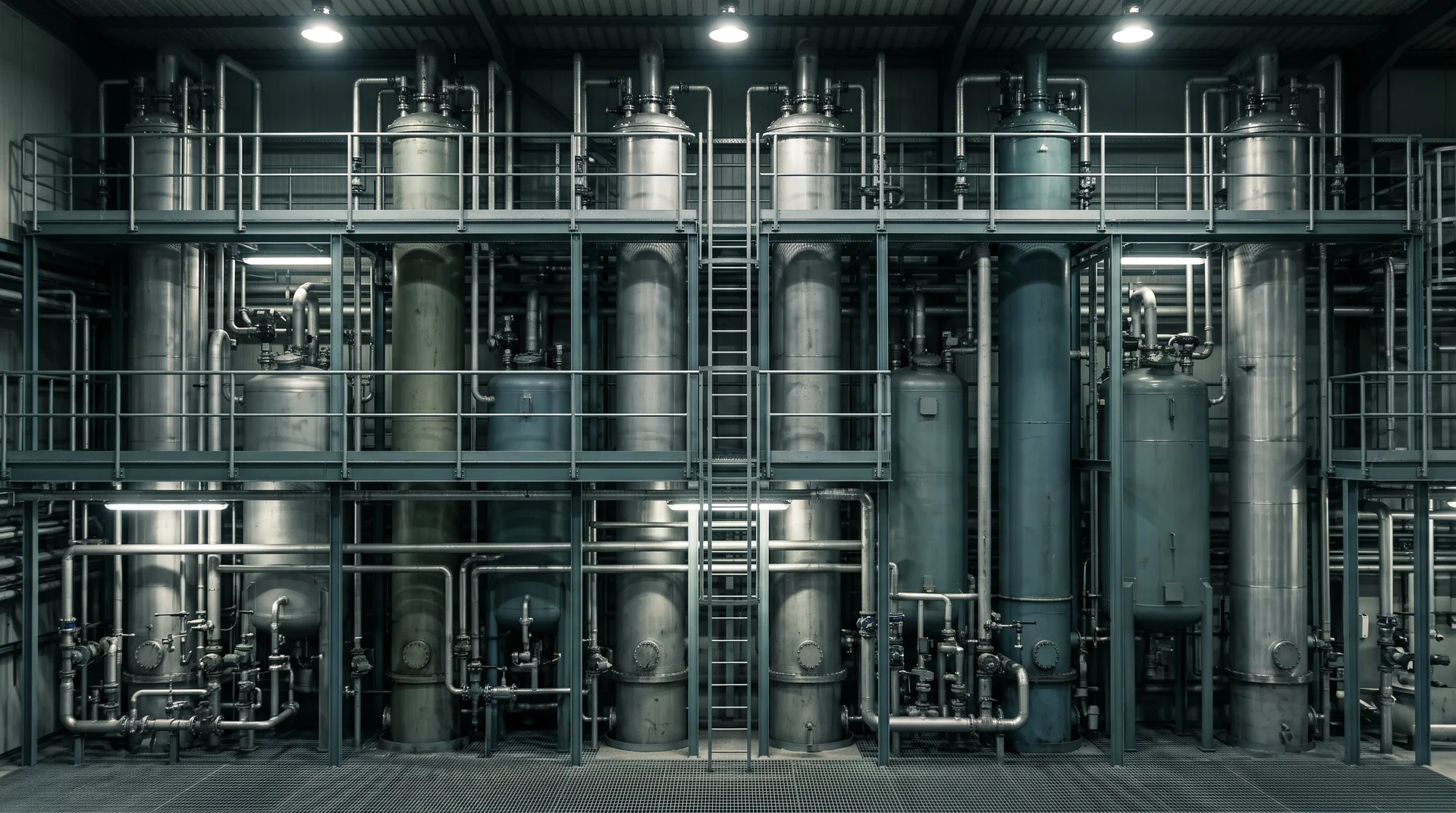
At the TiO₂ stage, on the same SCRREEN basis, the EU's import reliance is only about 18%, and it supplies the bulk of its own pigment. Europe has a real, established titanium-dioxide industry: plants that take titanium feedstock and turn it into the pigment that whitens paint, plastics and paper. This is genuine industrial capability, established and at scale. At the step where most of the value and volume sits, the continent is close to self-sufficient.
That reframes the whole problem: Europe's titanium challenge is not that it can't process titanium — it demonstrably can. The gap is on either side of the processing it already does well.
Titanium reaches Europe as imported ore, becomes pigment in European plants, and — where metal is needed — returns as imported metal. Europe owns the middle step and neither edge.
The two ends it doesn't
On both sides of that strong middle, Europe's position collapses to total dependence.
Upstream, at the ore stage, EU production of titanium mineral concentrate is about zero and import reliance is 100% (SCRREEN, 2016–2020). Every tonne of rutile and ilmenite that feeds those European pigment plants is imported. The continent that makes its own titanium white does not dig any of the rock it starts from.
Downstream, at the metal stage, the dependence is just as complete and arguably starker: EU import reliance is again 100%, and — the detail that matters — there is no EU titanium-sponge capacity at all. Sponge is the intermediate step that turns titanium feedstock into metal; without it, Europe cannot make primary titanium metal on its own soil, whatever that metal is later used for. (What that metal does once made — aerospace and the rest — is a separate story, told elsewhere in this hub.)
So the sandwich is real: a capable oxide middle, flanked by an ore end and a metal end where Europe produces essentially none of what it consumes. A supply strategy that only counted the pigment would miss both vulnerabilities entirely.
Where Orión fits — the ore end
Of Europe's two titanium gaps, one is a mineral-extraction problem, and that is the end a project like Orión speaks to. The discipline of this hub holds: only Osmond's published figures, and no claim the company hasn't made.
Mineral percentages here are mass-balance estimates — calculated from oxide assays rather than directly measured — and that basis applies to every mineral percentage in this article. Osmond describes Orión as rutile-dominant — rutile is the higher-grade titanium mineral — with rutile in the Zone 1 bulk channel samples at 13.36–13.49% (osm_grade). It reports that its initial titanium product would be a mixed titanium concentrate with a high rutile content, with dedicated titanium testwork ongoing and preliminary results expected in Q2 CY26 (osm_zircon) — a window that has since closed without a further result release cited here. That places Orión squarely at the ore/concentrate stage — precisely the end of the chain where the EU is 100% import-reliant.
The boundaries are the usual ones, and they matter. These are exploration and preliminary-testwork results, not a resource; a titanium mineral concentrate is feedstock, not pigment and not metal; and nothing here says Orión will supply European plants. What the stage analysis does explain is why an ore-stage titanium source on European soil is worth attention at all: the middle of the chain is covered, the metal end is a processing question, and the ore end is a mining question — the one thing a deposit can actually answer.
Orión data card — Titanium (with EU context)
| Status | Assayed / quantified |
| Bulk channel samples | Rutile 13.36–13.49% (mass-balance); rutile-dominant assemblage (osm_grade) |
| Processing | Mixed titanium concentrate, high rutile content; Ti testwork ongoing, results Q2 CY26 (osm_zircon) |
| EU by stage (SCRREEN, 2016–2020 basis, Ti content) | Ore/conc ~456,539 t/yr — 100% import-reliant · Oxide (TiO₂) ~425,694 t/yr — 18% import-reliant · Metal ~9,812 t/yr — 100% import-reliant, no EU sponge |
| Orión's stage | Ore/concentrate — the 100%-import-reliant end |
→ See the full Titanium dossier in the mineral hub.
Exploration results and mineralogical estimates only. Orión has no JORC-compliant Mineral Resource or Reserve; maiden MRE and Scoping Study pending, targeted Q3 CY26.
Sources
- Osmond figures: [osm_grade — 19 Feb 2026], [osm_zircon — 3 Mar 2026] (ASX:OSM releases)
- EU figures: SCRREEN2 Titanium factsheet (V1, Jan 2024), via Osmond source-of-truth v7.0 — EU consumption by stage (Ti content), 2016–2020 basis
- USGS Mineral Commodity Summaries 2024 — Titanium Minerals
Related reading
- Why aerospace still can't design titanium out (Applications · Rutile)
- The white in everything: ilmenite and TiO₂ pigment (Applications · Ilmenite)
- From outcrop to 187.8 metres: what the maiden drilling found (The Deposit · Rutile)
Sources
- PRIMARYosm_grade — ASX:OSM release, 19 Feb 2026 (bulk-sample rutile grades; rutile-dominant assemblage).
- PRIMARYosm_zircon — ASX:OSM release, 3 Mar 2026 (mixed titanium concentrate with high rutile content; titanium testwork ongoing, preliminary results Q2 CY26).
- SECONDARYSCRREEN2 Titanium factsheet (V1, Jan 2024), via Osmond source-of-truth v7.0 — EU consumption by stage, Ti content: ore/concentrate (Ti mineral concentrate) 456,539 t/yr, ~0 EU production, 100% import reliance; oxide (TiO₂) 425,694 t/yr, bulk of own supply, 18% import reliance; metal (Ti sponge/metal) 9,812 t/yr, ~0 EU production (no EU sponge capacity), 100% import reliance. VINTAGE: 2016–2020 averages.
- PRIMARYUSGS Mineral Commodity Summaries 2025 — Titanium Minerals (titanium mineral concentrates as feedstock for pigment and metal; rutile vs ilmenite TiO₂ content).