Minerals Hub / Sustainability / The tailings number a mining report must publish
Sustainability · · 5 min read
The tailings number a mining report must publish
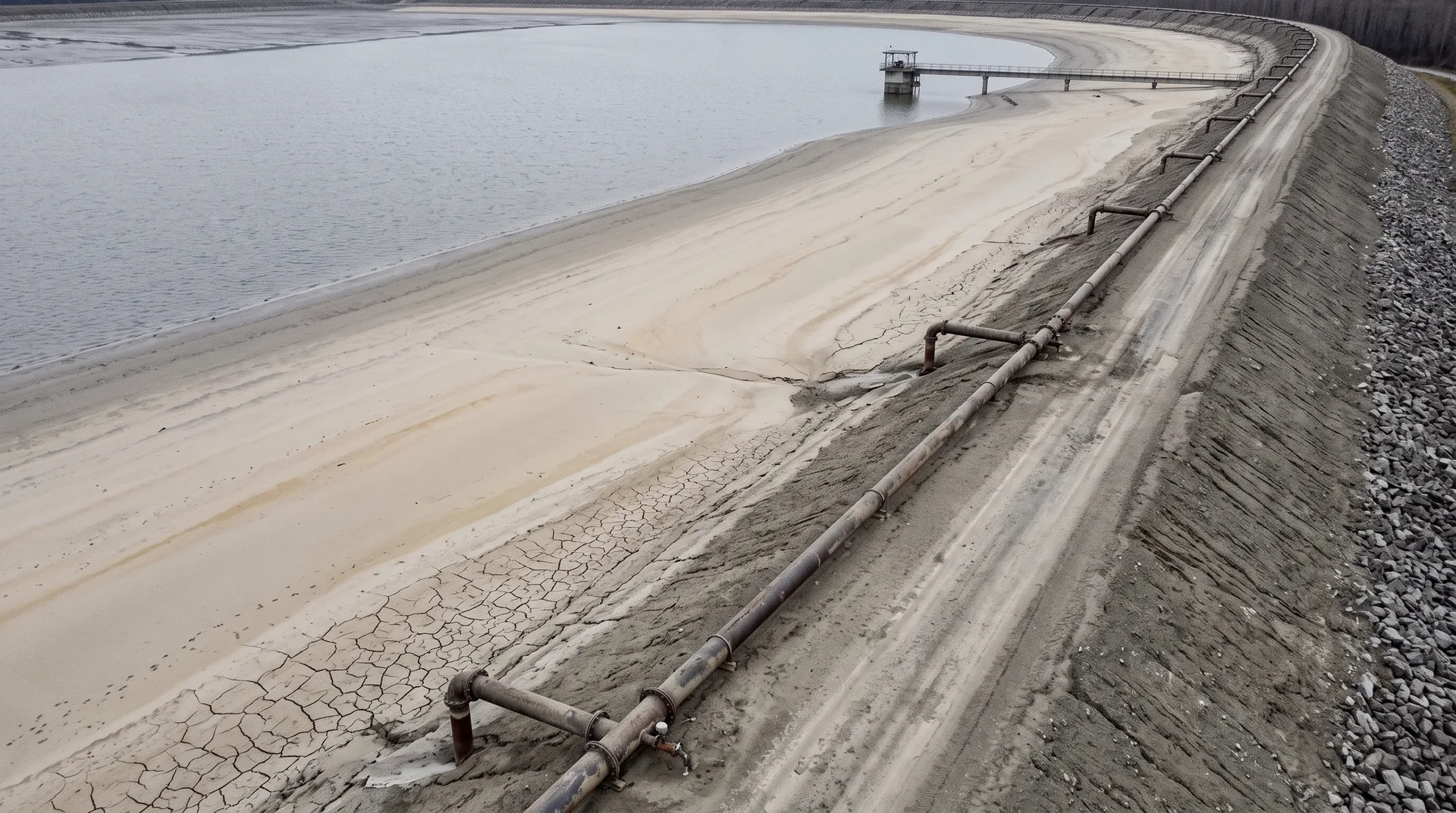
One sustainability disclosure requires a specific figure for each tailings facility — and defines it by pointing at an engineering standard, which is what stops it becoming a paragraph of intent.
Pending review
The short version
Most sustainability disclosure asks for narrative. A few requirements ask for a number, and those are the ones that change what a company has to know. GRI's mining sector standard requires a reporting organisation to list its tailings facilities and, for each one not confirmed to be in a state of safe closure, to publish a defined set of facts — including the Consequence Classification, defined not by the reporting standard but by pointing at Requirement 4.1 of the Global Industry Standard on Tailings Management. That cross-reference is the mechanism: a disclosure rule that borrows an engineering standard's definition cannot be answered with a paragraph about commitment.
Where the number comes from
The Consequence Classification is an engineering judgement about what happens if a tailings facility fails. The Global Industry Standard on Tailings Management, co-convened by ICMM, UNEP and PRI and dated August 2020, sets it in a single requirement.
Requirement 4.1 asks an operator to determine the classification "by assessing the downstream conditions documented in the knowledge base and selecting the classifi cation corresponding to the highest Consequence Classifi cation for each category in Annex 2, Table 1". The odd spacing is the document's own text layer; the printed word is "classification".
That sentence does three things at once. It makes the classification a function of what is downstream — population, environment, cultural and economic assets — not of the dam's size. It requires the highest classification across every category, so a facility that scores low on most and extreme on one is extreme. And it makes the result defensible and documented, which is the difference between an opinion and a finding.
The categories run Low, Significant, High, Very High and Extreme. The Standard's glossary contains no separate definition of the term — worth knowing before quoting one.
What the Standard itself says must be published
The disclosure obligation is separate, and sits in the Standard's final topic. Principle 15 is headed "Publicly Disclose and Provide Access to Information About the Tailings Facility to Support Public Accountability."
Requirement 15.2.B then sets out what that means for each existing facility, and it is a list of ten items to be published and updated at least annually. Among them: a "description of the tailings facility"; the "Consequence Classifi cation (Requirement 4.1)"; and the dates "of most recent and next independent reviews". On where, the Standard is deliberately unspecific: such disclosures "shall be made directly, unless subject to limitations imposed by regulatory authorities".
What the reporting standard adds
GRI 14: Mining Sector 2024 takes effect for reports published on or after 1 January 2026. Its tailings disclosure is where the two documents lock together.
A reporting standard that points at an engineering standard has borrowed a definition it cannot soften.
That is the whole of the mechanism. The reporting standard could have asked for a description of the company's approach to tailings risk, and been satisfied. Instead it asks for a classification determined under a named requirement of another document, plus a tonnage, plus two dates. Each of those either exists or does not, and a company that has not done the work has nothing to write in the box.
Note also the conditional. The detailed items apply to facilities "not confirmed to be in a state of safe closure" — the reporting boundary is a technical state, which itself has to be established rather than asserted.
A version note: GRI records that a version 1.1 was published in January 2026; whether it altered the tailings numbering was not established here, and the number cited above is the 2024 text's.
What the disclosures have shown
The requirement has a track record now, which is more instructive than the requirement alone.
ICMM's members committed to implement the Standard on a two-stage timetable: facilities with "extreme" or "very high" potential consequences "by 5 August 2023", and all other facilities "operated by members not in a state of safe closure" by "5 August 2025". After the second date passed, ICMM published a progress report stating that out "of the total of 836 ICMM member facilities, 67 per cent are in full conformance with the GISTM, while 33 per cent remain in partial conformance". ICMM's own characterisation was that achieving full conformance is taking longer than initially anticipated and remains a work in progress.
The number exists at all because the standard required a facility-level count, and the shortfall is visible for the same reason. A commitment framed as an intention would have produced no such figure, and no way of being behind on it.
And when there is no facility
A company with no tailings facility has no Consequence Classification to report, because the engineering standard attaches to facilities and their operators. That is a structural exclusion rather than an exemption.
The reporting standard handles the same situation differently, and the difference is the more interesting one. GRI 14 covers organisations undertaking exploration as well as extraction and primary processing; where an organisation determines that a topic in the standard is not material, it is required to list that topic in its GRI content index and explain why. So the honest position for a company without operations is not silence but a stated and reasoned absence — which is a smaller obligation than a producer's, and a different thing from having nothing to say.
Related
- Responsible Mining — the standards and audit regimes that assess
- Environmental Management — the site controls behind the reported figures
- Circular Economy — why extractive residues sit under their own
- Water — the other area where reported figures are
Sources
- PRIMARYGlobal Industry Standard on Tailings Management, co-convened by ICMM, UNEP and PRI, August 2020; the Global Tailings Review was the convening process and host, not the attribution line the cover gives. Requirement 4.1 quoted as printed (the PDF's text layer renders 'classification' as 'classifi cation'; the printed word is classification). Principle 15 heading and Requirement 15.2.B quoted. Requirement 15.2.B lists ten items to be published and updated at least annually for each existing tailings facility; items 1, 2 and 9 are quoted here. The Standard's glossary contains no standalone entry for 'Consequence Classification' — it is defined operationally by Requirement 4.1 together with the matrix at Annex 2, Table 1, whose levels are Low, Significant, High, Very High and Extreme.
- PRIMARYGRI 14: Mining Sector 2024, Global Reporting Initiative. Cover states 'SECTOR STANDARD 14' and 'EFFECTIVE DATE: 1 JANUARY 2026'; front matter: 'This Standard is effective for reports or other materials published on or after 1 January 2026.' Disclosure 14.6.3 quoted in full. The PDF carries no announcement or publication date. NOTE ON VERSION: GRI's own standards page states that 'The latest version (V1.1) of GRI 14, published in January 2026, has been aligned with the revised GRI 102: Climate Change 2025 and GRI 103: Energy 2025 Topic Standards.' The text and numbering quoted here are from the 2024 version; whether V1.1 altered the 14.6.x tailings numbering was not established. URL given is a full-text copy of the English standard; the official landing page is https://www.globalreporting.org/standards/standards-development/sector-standard-for-mining/
- PRIMARYInternational Council on Mining and Metals, GISTM commitment page: 'All ICMM members committed to implement the Standard. All tailings facilities operated by members with "extreme" or "very high" potential consequences will be in conformance with the Standard by 5 August 2023. All other tailings facilities operated by members not in a state of safe closure will be in conformance with the Standard by 5 August 2025.'
- PRIMARYInternational Council on Mining and Metals, Tailings Progress Report, published November 2025: 'Out of the total of 836 ICMM member facilities, 67 per cent are in full conformance with the GISTM, while 33 per cent remain in partial conformance.' The report also characterises full conformance as taking more time than initially anticipated and as remaining a work in progress; two slightly different phrasings of that characterisation were returned by the report page and the accompanying news release, so it is reported here as ICMM's characterisation rather than quoted.
- UNVERIFIEDGAP — whether GRI 14 version 1.1 (January 2026) changed the numbering or wording of the tailings disclosures was not established for this article. The disclosure numbers cited are those of the 2024 version.Non-public document · no public URL