Minerals Hub / Mining & Production / Reading the Orión seams: what the heavy-mineral layers tell us
Mining & Production · Rutile · 6 min read
Reading the Orión seams: what the heavy-mineral layers tell us
Orión's heavy minerals are sorted into dense layers within the quartzite — and reading those layers is where its zircon story begins.
Reviewed by Peter Uppal
The short version
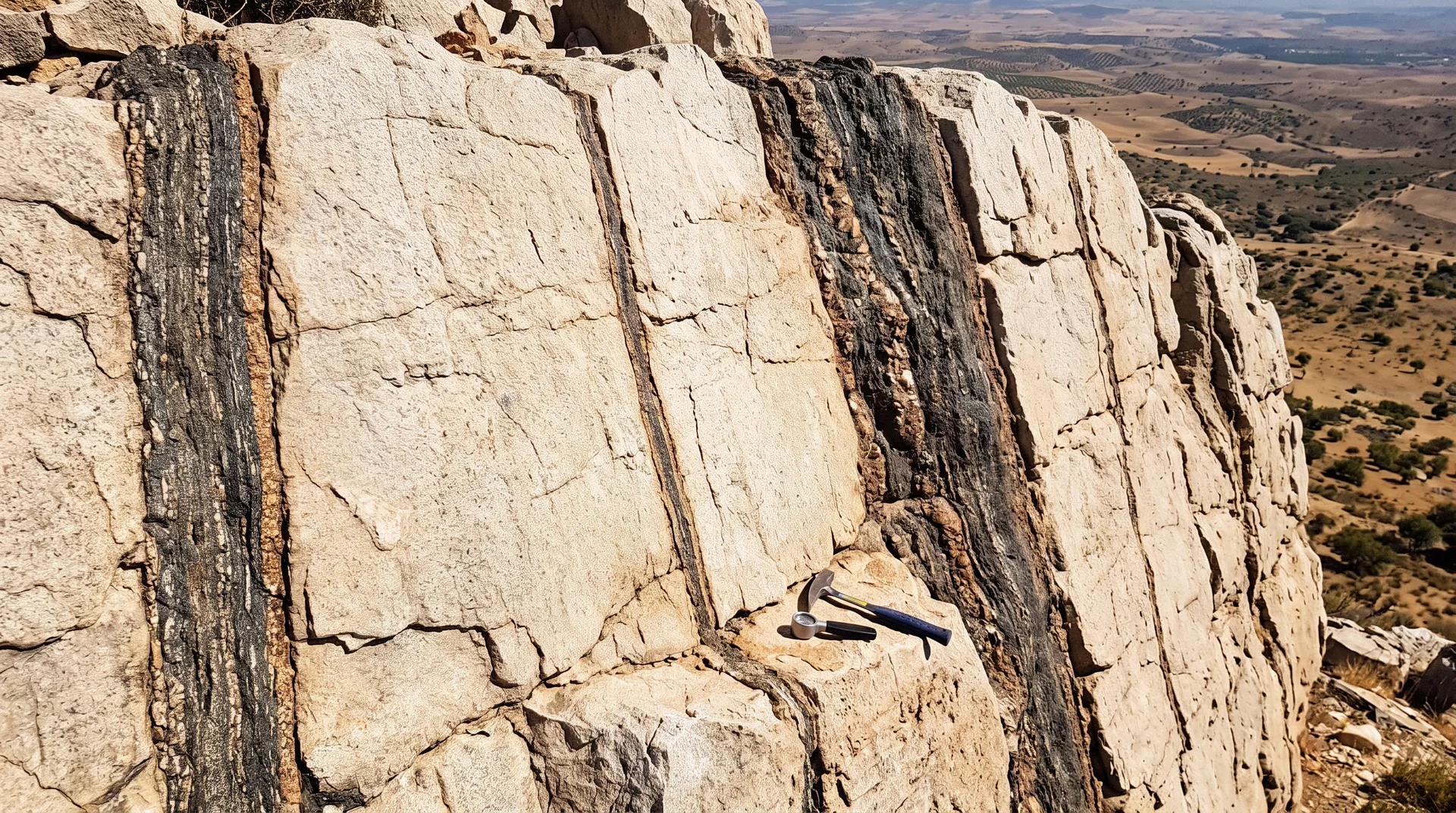
Osmond describes Orión as a lithified tidal-sand placer — an ancient beach now hardened into quartzite — across a 232 km² permit, with heavy-mineral layers reported at 0.3–4.0 m thick (ASX releases). Those layers are where the deposit concentrates the minerals Osmond is chasing, zircon among them, with Zone 1 bulk channel samples returning 8.77–9.79% zircon (osm_grade, 19 Feb 2026). These mineral percentages are mass-balance estimates — calculated from oxide assays rather than directly measured — and that basis applies to every mineral percentage in this article. (Separately, Osmond's website — not its releases — describes two primary seams that "appear to be pervasive" across the permit, over some 12 km of outcrop.) No resource has been estimated yet.
Sorted by ancient tides
To read Orión, start with how it formed. Osmond describes the deposit as a lithified tidal-sand placer — in plain terms, an old shoreline where wave and tidal action sorted sand grains by weight, letting the dense, durable minerals settle together into layers. Over geological time those sands were buried, compressed and cemented into rock: at Orión, a weakly laminated quartzite of the Pochico Formation (osm_grade, 19 Feb 2026).
The origin story does practical work here. In a placer, moving water does the sorting: the light quartz is winnowed away while the dense, valuable minerals settle and pile up into bands. (As general background, not an Osmond figure: this is the same process that builds modern mineral-sand beaches, only here it happened long ago and the sand has since hardened.) Osmond also notes the deposit carries "very low levels of deleterious elements" — few of the contaminants that complicate processing elsewhere (osm_grade, 19 Feb 2026).
The layers — and a claim about how far they run
Here it helps to separate two different kinds of statement, because Osmond's own materials do.
What the ASX releases pin down are the physical layers and the permit: heavy-mineral layers 0.3 to 4.0 metres thick (osm_grade, 19 Feb 2026), within a permit of 232 km² across 772 mining units — the corrected, current figure (osm_drivers, 3 Jul 2026). Those are drilled-and-mapped dimensions in the released record.
The broader claim of lateral continuity comes from Osmond's website, not its releases, and it is worth quoting with the company's own hedge intact: geological mapping, the site says, has identified "two primary seams that appear to be pervasive" across the permit, with mineralised outcrops over some 12 kilometres and three target zones. The words "pervasive" and "12 km" do not appear in the assay release — so they belong here as the website's mapping interpretation, not as a drilled result.
The distinction matters more than it might seem. If that mapping holds, being able to trace a mineralised horizon across kilometres of outcrop would be genuinely useful — layers you can map and sample at surface, before a rig is involved. But lateral persistence across a whole permit is exactly the kind of claim a maiden resource estimate exists to test.
On concentration, the releases give a headline rather than a ceiling: Osmond reports heavy minerals "up to 30%" at the headline level (mass-balance; osm_drivers, 3 Jul 2026). That is a headline figure, not a measured maximum — individual bulk and interval estimates elsewhere in the released record sit above it, including the ~40% heavy minerals estimated for the AV-01bis discovery interval (mass-balance; osm_grade, 19 Feb 2026).
Why the layering matters for zircon
Zircon is one of the economic minerals Osmond names in the assemblage, alongside rutile, ilmenite and monazite. In the Zone 1 bulk channel samples, zircon runs 8.77% to 9.79% (mass-balance), with the corresponding zirconium oxide (ZrO₂) at 5.07% to 5.57% on an oxide basis (osm_grade, 19 Feb 2026).
The layering matters because it determines what a processing plant would eventually be fed. Preliminary metallurgical testwork has already taken material from these layers and produced a combined zircon concentrate grading 50.2% ZrO₂ (by mass, of concentrate) at about 70% recovery, with Osmond targeting ≥66% ZrO₂ — the grade Osmond calls premium — in the next round of testwork (osm_zircon, 3 Mar 2026). Zircon also carries hafnium: hafnium is invariably present in zircon, substituting for zirconium in the mineral's structure. That mineralogy is settled science, not an editorial reading; what is ours is only the commercial characterisation of Osmond's results. The hub's hafnium coverage picks the mineralogy up separately.
What makes the testwork meaningful is that the heavy minerals sit in defined, sampleable layers rather than scattered through the rock. The concentration the assays measured is real, whatever the eventual mapping of the layers' full extent turns out to show.
From layers to a resource
A word of caution is built into all of this. Orión has no JORC-compliant Mineral Resource or Reserve yet. The mapped layers, the surface outcrops and the drill intercepts along them are the raw material for a maiden Mineral Resource Estimate, which Osmond has targeted before the end of Q3 CY26 (osm_drivers, 3 Jul 2026).
What the layers tell us today is geological, not economic: an ancient tidal beach, lithified into quartzite, concentrated heavy minerals into layers that can be sampled at surface. How far those layers persist across the permit is what the website's mapping proposes — and what a resource estimate will actually test. That is the foundation; the numbers that turn a foundation into a resource come next.
The grades are measured; the map is still a map. Keeping those two apart is how you read an early deposit honestly.
Orión data card — Zircon
| Status | Assayed / quantified — exploration results only |
| In the layers (Zone 1 bulk channel samples) | Zircon 8.77–9.79% (mass-balance); ZrO₂ 5.07–5.57%, oxide basis (osm_grade, 19 Feb 2026) |
| Preliminary concentrate | 50.2% ZrO₂ (by mass, of concentrate) at ~70% recovery; target ≥66% ZrO₂, Osmond's "premium" (osm_zircon, 3 Mar 2026) |
| Deposit (releases) | Lithified tidal-sand placer, Pochico Fm quartzite; HM layers 0.3–4.0 m; permit 232 km² / 772 units |
| Heavy minerals (headline, not a ceiling) | "Up to 30%" at headline level (mass-balance; osm_drivers, 3 Jul 2026) |
| Mapping (website, not releases) | Two primary seams that "appear to be pervasive"; ~12 km outcrop; three target zones [WEB] |
→ See the full Zircon dossier in the mineral hub.
Exploration results and mineralogical estimates only. Orión has no JORC-compliant Mineral Resource or Reserve; maiden MRE and Scoping Study pending, targeted Q3 CY26.
Related reading
- From outcrop to 187.8 metres: what the maiden drilling found (The Deposit · Rutile)
- From 50.2% to premium: the zircon target (Science · Zircon)
- What a lithified placer actually is (Science)
- Explored for uranium. Worked for lead. Not, on the record, for titanium. (The Deposit)
Sources
- PRIMARYosm_grade — ASX:OSM release, 19 Feb 2026 (bulk-sample grades Table 3; heavy-mineral layer thickness 0.3–4.0 m, p.17; lithified tidal-sand placer / siliciclastic geological system, p.18).
- PRIMARYosm_zircon — ASX:OSM release, 3 Mar 2026 (zircon concentrate grades, p.1, p.3).
- PRIMARYosm_drivers — ASX:OSM release, 3 Jul 2026 (project area 232 km² / 772 units, p.1, p.6; heavy minerals 'up to 30%', p.1).
- SECONDARYosmondresources.com.au, Orión project page [WEB] — 'two primary seams that appear to be pervasive' across the permit; mineralised outcrops over ~12 km; three target zones. A website claim, attributed as such in the text and not linked.Non-public document · no public URL
- COMMON-KNOWLEDGEGeneral geology of placer deposits and lithification — standard reference knowledge; not an Osmond figure.Non-public document · no public URL
- COMMON-KNOWLEDGEGeneral mineralogy — hafnium's invariable occurrence in zircon (see the hafnium reference page)Non-public document · no public URL